

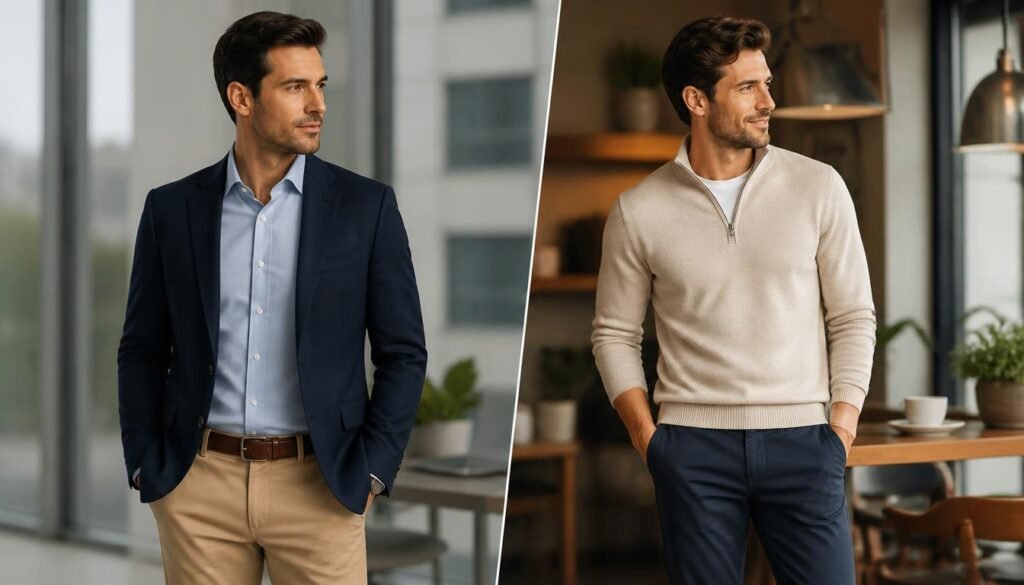
Business casual vs smart casual both sit between a full suit and pure casual wear, but business casual is built around structure and professional trust, while smart casual is built around personality within polished boundaries. The two dress codes overlap enough to confuse most men, and the wrong choice, too relaxed for a client meeting or too stiff for a Friday dinner, is an easy mistake to make. This guide breaks down exactly where they differ and how to choose correctly for any occasion.
Business Casual vs Smart Casual: The Quick Answer
| Business Casual | Smart Casual | |
|---|---|---|
| Purpose | Professional trust | Polished personality |
| Structure | Tailored trousers, structured blazer | Softer jackets, casual knits |
| Fabrics | Wool blends, fine cotton, poplin, twill | Textured knits, brushed cotton, dark denim |
| Colours | Navy, charcoal, muted neutrals | Wider palette, patterns, texture |
| Shoes | Oxfords, brogues, polished loafers | Suede shoes, clean trainers, dress boots |
| Best for | Client meetings, interviews, traditional offices | Dinners, dates, creative workplaces, weekends |
What Is Business Casual for Men?
Business casual is traditional office wear with the strictest elements relaxed, the tie removed, the fabric softened slightly, while the overall structure stays intact. Think tailored trousers or sharp chinos, a collared shirt, and a structured blazer. For the full breakdown of pieces and outfit formulas, see our dedicated guide to business casual for men.
What Is Smart Casual for Men?
Smart casual starts from the opposite direction, casual wear with sharper elements added, a blazer, leather shoes, a considered colour palette. It allows more personal expression than business casual while still requiring a clean, put-together look. Our guide on what smart casual actually means covers the definition and history in more depth.
The Details That Actually Mark the Difference
- Structure. Business casual keeps defined shoulders and a tailored silhouette. Smart casual allows unstructured blazers and a more relaxed fit.
- Fabric. Business casual favours wool blends and fine, smooth cotton. Smart casual welcomes texture, brushed cotton and clean denim.
- Footwear. Business casual stays within leather dress shoes and polished loafers. Smart casual opens the door to suede, dress boots and refined trainers.
- Colour. Business casual leans neutral and muted. Smart casual allows more pattern and personality, provided the overall look stays considered.
When to Wear Each One
Industry and context do most of the deciding. Traditional fields, finance, law, client-facing corporate roles, lean toward classic business casual: dress shirts, tailored trousers, leather shoes. Creative and tech environments often default to smart casual: unstructured blazers, refined trainers, elevated knitwear. Outside work, smart casual covers most social occasions that call for more effort than jeans and a t-shirt, dinners, engagement parties, less formal weddings, while business casual is largely confined to the office and client-facing settings. If your company has a formal written policy, it’s worth checking it against ACAS guidance on workplace dress codes, since UK employers are expected to apply any dress code fairly and consistently. For office-specific guidance, see our men’s office wear guide.
Common Mistakes With Business Casual vs Smart Casual
- Confusing athleisure with either code. Gym wear, trainers built for sport, and anything with a visible logo undermine both looks.
- Ignoring fit. A well-fitted budget piece consistently outperforms an expensive one that doesn’t fit properly, for both dress codes.
- Neglecting maintenance. Scuffed shoes and creased shirts sabotage even a well chosen outfit.
- Going too far in either direction. Over-formal reads as stiff in a smart casual setting; under-dressed reads as careless in a business casual one.
Building a Wardrobe That Covers Both
Most men don’t need two entirely separate wardrobes to handle the business casual vs smart casual split. A handful of versatile pieces, a good blazer, tailored trousers, a couple of well-fitted shirts, a smart pair of shoes and a cleaner trainer, can flex between both codes with small swaps. This is essentially a capsule wardrobe approach applied to menswear; see our guide to building a capsule wardrobe for how to make a small rotation of pieces work across both dress codes. For everyday outfit combinations specifically, our smart casual outfit guide has ready-made formulas.
Business Casual vs Smart Casual: A Quick Decision Test
When you’re standing in front of the wardrobe unsure which way to go, a simple test helps settle the business casual vs smart casual question fast: ask whether the event is about being trusted or being liked. Client meetings, interviews and traditional offices are trust-based, business casual wins. Dinners, dates and creative workplaces are more about personality, smart casual wins. If the event genuinely sits in between, a smart casual outfit built with slightly sharper pieces, a structured blazer instead of a soft one, leather shoes instead of trainers, usually bridges the gap without looking out of place either way.
Business Casual vs Smart Casual Beyond the Office
The business casual vs smart casual question doesn’t stop at work. Wedding invitations, restaurant dress codes and members’ clubs increasingly use both terms, often without much consistency between venues. When a dress code simply says “smart”, treat it as smart casual unless the venue is unusually formal. When an invitation specifically says “business attire” or “business casual”, lean toward the more structured end of the spectrum, tailored trousers, a collared shirt, leather shoes, even outside a work context.
Frequent travellers face this business casual vs smart casual decision often too, since business-class lounges, client dinners abroad and conference dress codes vary by country and industry far more than UK offices tend to. Packing two or three pieces that flex between both codes, a blazer, a versatile knit, one pair of leather shoes, removes most of the guesswork before you even land.
Does the business casual vs smart casual distinction matter for job interviews?
Yes, and it’s worth erring toward business casual specifically for interviews, even at companies with a relaxed everyday dress code, since first impressions in a hiring context tend to favour the more structured, trust-signalling end of the scale.
How has the business casual vs smart casual line shifted since remote work became common?
Smart casual has become the default in far more workplaces since hybrid and remote work became widespread, with strict business casual now largely reserved for client-facing days, interviews and traditional sectors like finance and law.
Frequently Asked Questions
Is smart casual more or less formal than business casual?
Smart casual is generally slightly less formal than business casual, though the two overlap enough that context matters more than a strict hierarchy. Business casual prioritises structure and professional trust; smart casual prioritises polish with more personal expression.
Can trainers work for either dress code?
Clean, minimal leather trainers can work for smart casual and, in more relaxed offices, for business casual too. Sport-branded or heavily logoed trainers don’t suit either code.
What’s the safest choice if I’m unsure of the dress code?
Err slightly more formal. It’s easier to remove a tie or swap a blazer for a cardigan on arrival than to compensate for being underdressed.
Do business casual and smart casual differ by industry?
Yes. Finance, law and traditional corporate roles tend to interpret business casual more strictly, while creative and tech workplaces often treat smart casual as their default, sometimes even for client-facing days.



Leave a Reply