

Business casual men wear today is traditional office wear with the strictest elements relaxed, no tie, softer fabrics, while the overall structure and professionalism stay intact. It’s the standard dress code across most modern offices, sitting between a full suit and smart casual on the formality scale.
What Business Casual Men Should Wear
Business casual keeps the bones of traditional office wear, tailored trousers, a collared shirt, a structured blazer, while dropping the tie and allowing slightly softer fabrics. The goal is professional trust rather than personal expression, which is why the colour palette and silhouette stay more conservative than smart casual. For how it compares directly against the more relaxed alternative, see our business casual vs smart casual guide.
Core Pieces for a Business Casual Wardrobe
- Tailored trousers or sharp chinos. Navy, charcoal or grey, cut close enough to look intentional without being tight.
- Collared shirts. Fine cotton, poplin or twill, in solid colours or subtle patterns, this is the backbone of the wardrobe.
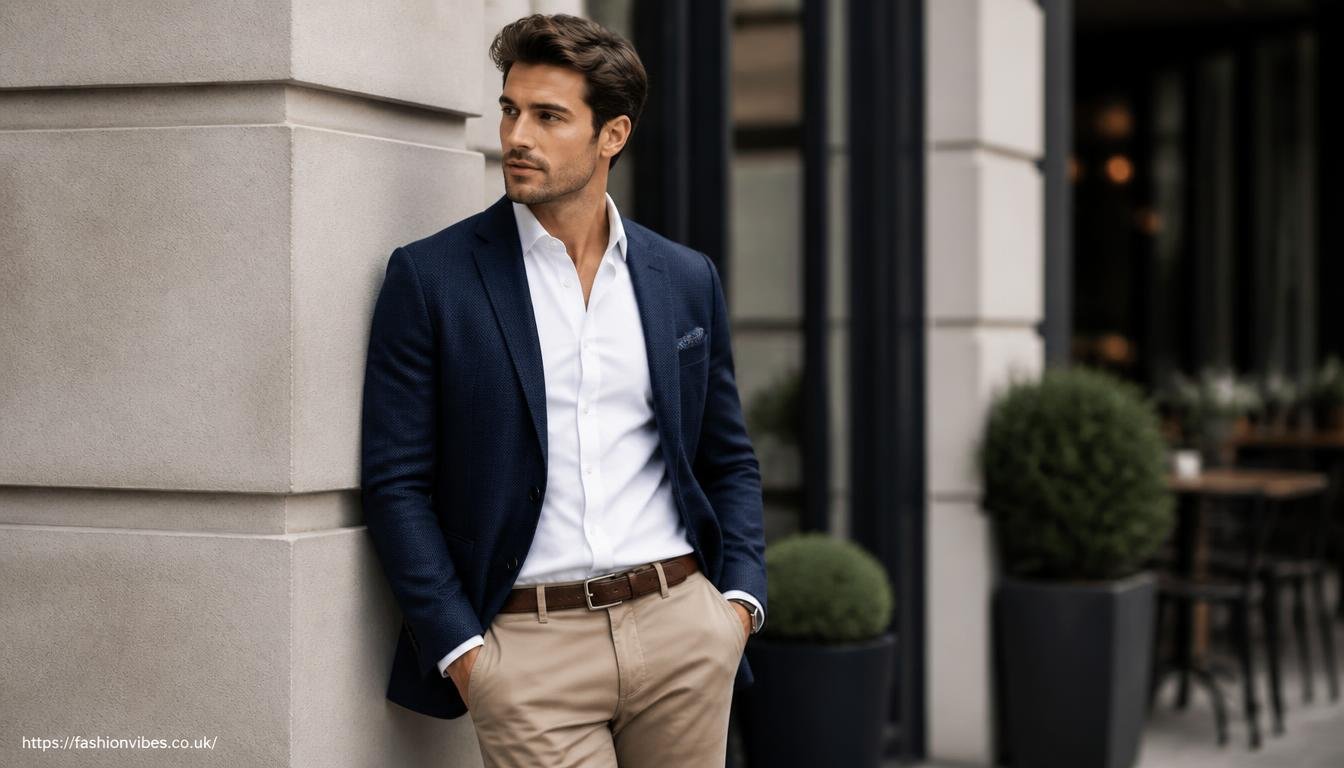
- A structured blazer. Navy or charcoal works with almost every trouser and shirt combination in the rotation, a tailored silhouette rooted in the same British tailoring tradition that still shapes most office wear today.
- Leather dress shoes or polished loafers. Oxfords, brogues or a clean loafer, always leather, always well maintained.
- A quality knit. A fine-gauge jumper worn under a blazer or over a shirt adds warmth without breaking the professional look.
Business Casual Outfit Formulas
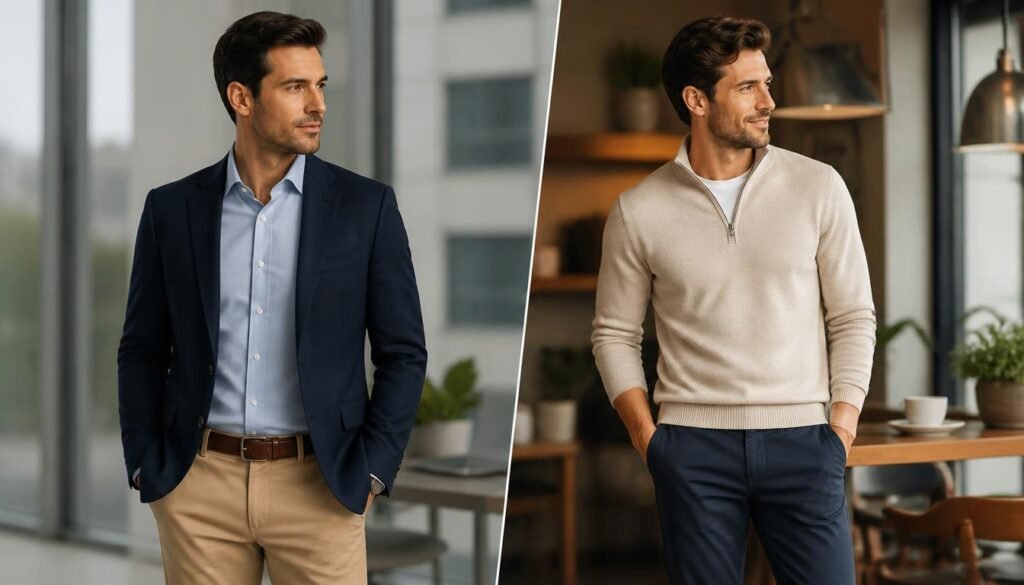
- Shirt + tailored trousers + blazer + leather shoes. The default, safe for almost any client meeting.
- Shirt + chinos + loafers, no blazer. A step more relaxed, works for internal meetings and everyday office days.
- Knit + collared shirt underneath + trousers. A layered look that reads professional while adding texture.
- Blazer + smart trousers + fine knit instead of a shirt. Slightly more modern, still within business casual boundaries.
What to Avoid in Business Casual
- Sport-branded trainers. Even clean, minimal ones tend to undercut business casual specifically, more so than smart casual.
- Distressed or heavily washed denim. Business casual rarely accommodates denim at all in traditional workplaces.
- Graphic tees or visible logos. These read as casual rather than business casual, regardless of quality.
- Wrinkled or ill-fitting shirts. Fit and finish matter more in business casual than in almost any other code, since there’s less room to hide behind personality or texture.
Business Casual by Industry
Interpretation varies significantly by sector. Finance, law and traditional corporate roles tend to enforce a stricter version, tie sometimes still expected on client days, minimal colour variation. Creative and tech workplaces often use “business casual” loosely to mean smart casual in practice. When starting a new role, it’s worth checking what colleagues actually wear on a normal day rather than relying on the policy wording alone. Our men’s office wear guide covers how to read workplace dress codes more broadly.
Building a Business Casual Wardrobe on a Budget
Start with one navy blazer, two pairs of trousers in navy and grey, three to four shirts in solid colours, and one pair of leather shoes. This small rotation covers a full working week with minimal repetition once pieces are mixed. Add pieces gradually rather than buying a full wardrobe at once, prioritising fit and fabric quality over quantity, the same logic behind a capsule wardrobe applies directly to business casual dressing.
How to Care for a Business Casual Wardrobe
Business casual relies more heavily on maintenance than almost any other dress code, since a wrinkled shirt or a scuffed shoe undoes a well-chosen outfit instantly. A weekly ten-minute routine, checking shirts for wrinkles before they’re worn again, wiping down leather shoes, hanging blazers properly rather than folding them, keeps the whole rotation looking sharp without needing to buy new pieces more often than necessary. Shoe trees are worth the small investment too, they help leather shoes hold their shape between wears and extend how long a pair genuinely lasts.
Fabric choice affects how much upkeep a piece needs. Wrinkle-resistant cotton blends and merino wool knits tend to need less ironing and hold their shape better across a working week than pure cotton or cheaper synthetic blends, which is worth factoring in when deciding where to spend more on a piece.
Business Casual for Different Body Types
Fit matters more than any specific piece in business casual, and the same blazer or trouser cut won’t suit every build the same way. A structured blazer with defined shoulders tends to add shape for slimmer frames, while a softer, less padded shoulder often sits better on broader builds. Trousers cut with a slight taper generally look more intentional than either very slim or very loose fits, regardless of height or build. Getting one or two key pieces properly tailored, even a basic hem or a waist adjustment, tends to make a bigger visible difference than buying additional items.
How often should business casual pieces be replaced?
Well-made trousers and blazers can reasonably last three to five years with proper care, while shirts and shoes in regular rotation typically need replacing sooner, shirts due to collar wear and shoes due to sole wear.
Is business casual different for younger professionals starting their first job?
The core principles stay the same, but it’s reasonable to start with a smaller, more budget-conscious rotation, a couple of trousers, a handful of shirts, one blazer, and build it out gradually as the role and wardrobe both develop.
Frequently Asked Questions
Is business casual the same as smart casual?
No. Business casual is generally more formal and structured, closer to traditional office wear with the tie removed. Smart casual starts from casual wear and adds polish. See our full comparison for the details.
Can I wear jeans for business casual?
Rarely, and only in more relaxed workplaces. Traditional business casual generally excludes denim in favour of tailored trousers or chinos.
Do I need a tie for business casual?
Usually not. Business casual is defined partly by the absence of a tie compared to business formal, though some client-facing roles still expect one.
How many pieces do I need for a business casual wardrobe?
A working rotation of around 10–15 pieces, blazers, trousers, shirts and shoes, is usually enough to cover a full working week without obvious repetition.



Leave a Reply