


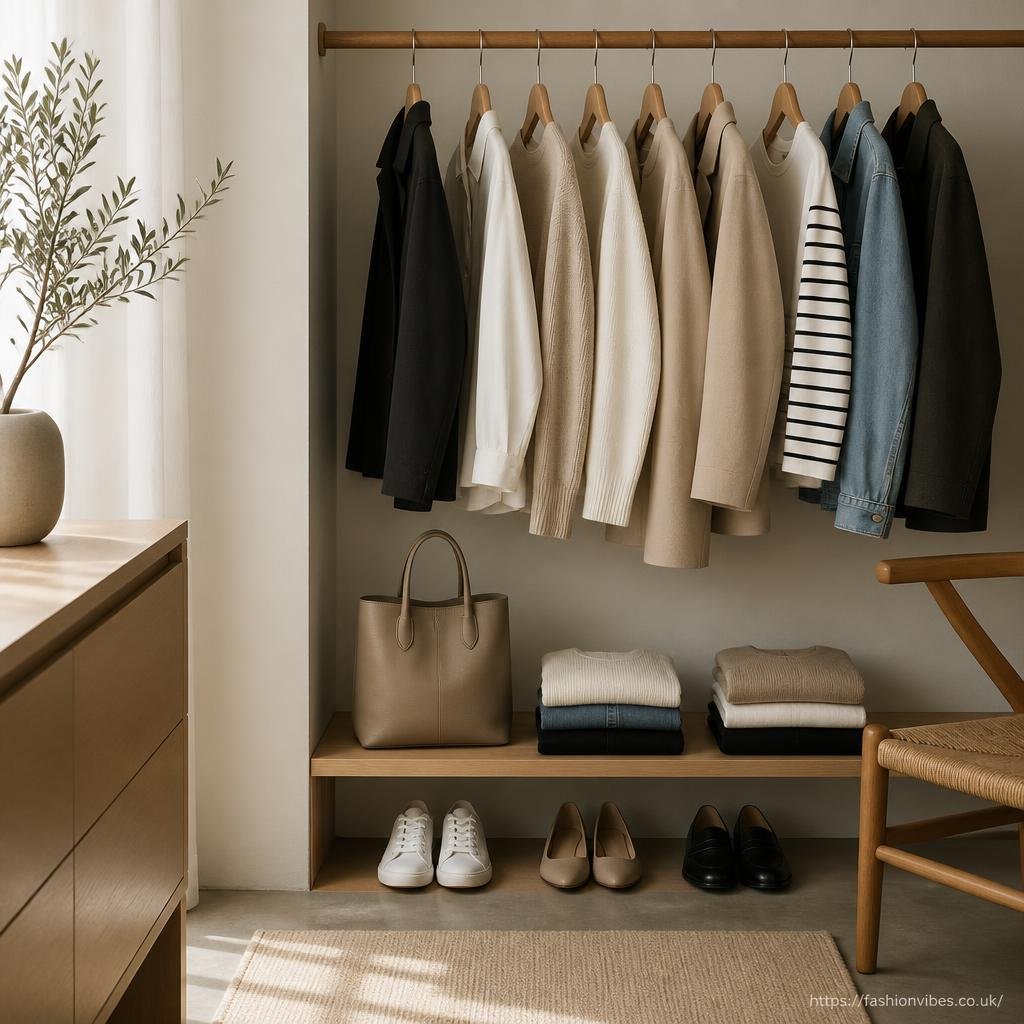
A closet capsule is the process of auditing an entire wardrobe and rebuilding it around a coordinated set of pieces, rather than a specific item count. While “capsule wardrobe” often refers to the finished result, “closet capsule” is commonly used to describe the whole-closet process: working through everything you own, keeping what earns its place, and organising what remains so it’s genuinely easy to get dressed from.
What Is a Closet Capsule?
The phrase is largely interchangeable with capsule wardrobe, but it leans slightly more toward the closet itself, the physical space and how it’s organised, rather than just the finished list of pieces. A closet capsule approach usually starts with everything you own, sorts it methodically, and ends with a rail where every hanger holds something you actually wear.
Step 1: Empty and Audit the Closet
Take everything out, or at minimum, go through it garment by garment rather than skimming. For each piece, ask three questions: does it fit, does it work with at least a few other things you own, and have you worn it in the last year. A simple hanger trick helps if you’re not ready to remove things yet, turn every hanger the same direction, then flip it back only once you’ve worn the item. After a month, whatever hasn’t moved is a strong candidate to remove.
Step 2: Sort Into Three Piles
- Keep – fits, flatters, gets worn, and works with your palette.
- Alter or repair – good pieces let down by a hem, a missing button or a loose thread.
- Remove – donate, sell or recycle anything that doesn’t fit the above.
A useful test at this stage is the Rule of 5: only keep items that can be paired with at least five other pieces already in the keep pile. It’s a fast way to spot orphan items that look fine on their own but don’t actually integrate with anything else.
Step 3: Organise What Stays
Once the keep pile is set, organise the closet itself so the capsule is easy to use day to day. Grouping by category (tops, bottoms, dresses, outerwear) tends to work better than grouping by colour alone, since most people get dressed by garment type first. Keep the pieces you reach for most at eye level, and store off season items elsewhere so the active closet capsule stays small and genuinely usable.
Step 4: Identify Gaps and Shop Deliberately
With everything organised, gaps in the closet capsule usually become obvious, five tops but nothing to pair them with, or plenty of occasion wear but no reliable everyday trousers. Write the gaps down and shop for them over time rather than all at once. For a full walkthrough of turning a closet audit into a finished capsule wardrobe, see our step-by-step building guide.
Closet Capsule vs Micro Wardrobe
A closet capsule describes the process, working through an entire closet and rebuilding it, while a micro wardrobe describes a specific, very small outcome (10–15 pieces). You can use the closet capsule process and land on a much larger, 30–40 piece result, or use the same process and deliberately edit down to a micro wardrobe. The process and the target size are separate decisions.
Maintaining a Closet Capsule
A closet capsule isn’t a one-off project, it needs light maintenance to stay useful. Revisit it each season, swapping heavier and lighter pieces as the weather changes, and apply a one-in, one-out rule to new purchases so the closet doesn’t quietly refill with items that don’t earn their place. For UK weather specifically, keep an eye out for transitional pieces each spring and autumn; our M&S transitional fashion items roundup is a useful starting point.
Tools That Make a Closet Capsule Easier
A few simple additions make maintaining a closet capsule considerably easier day to day. Matching hangers, rather than a mismatched pile from various shops, make a rail look instantly more organised and easier to scan at a glance. Clear storage boxes for off-season pieces mean you can identify what’s inside without opening every box, which matters when you’re swapping pieces in and out seasonally. A full-length mirror positioned near the closet also helps, since trying combinations on properly rather than guessing from the hanger tends to surface gaps and mismatches faster.
None of this needs to be expensive. A basic set of matching hangers and a couple of labelled boxes cover most of what a closet capsule actually needs to function well.
Common Closet Capsule Mistakes
- Sorting by colour instead of category first. Most people get dressed by garment type, tops, then bottoms, so organising that way first makes the closet easier to use day to day.
- Keeping “just in case” pieces indefinitely. An occasion outfit worn once in three years is reasonable to keep; ten of them clutter a small closet capsule without adding real value.
- Ignoring the alter-or-repair pile. Pieces left in limbo, not quite kept, not quite removed, tend to sit unworn for months. Set a two-week deadline to actually get them altered or let them go.
How often should a closet capsule be fully re-audited?
Once a year works well for most people, ideally at a season change, alongside the lighter quarterly swaps between warm and cool weather pieces.
What’s the biggest difference a closet capsule makes day to day?
Most people notice mornings getting faster almost immediately, since every hanger holds something wearable rather than requiring a search through pieces that don’t fit or don’t suit the day.
Frequently Asked Questions
Is a closet capsule the same as a capsule wardrobe?
They’re closely related. “Closet capsule” usually refers to the process of auditing and reorganising an entire wardrobe, while “capsule wardrobe” more often describes the finished, coordinated result.
How long does a closet capsule audit take?
A thorough first audit typically takes a few hours to a full day, depending on the size of the wardrobe. Sorting and organising what remains can be spread across a weekend.
Should I remove everything from my closet at once?
It can work, but many people find a slower, garment-by-garment audit less overwhelming and easier to stick with than a single big purge.












Leave a Reply